
Instructional arrangement refers to the code used by the school district to document the instructional setting for attendance purposes. All students receiving special education services must have an instructional setting code. Your child can only have one setting code. This setting code is often at the end of the individual education program (IEP) and can tell families a great deal about their child‘s placement.
Under previous funding structures, instructional setting (e.g., general education or special education classroom, home, hospital, off home campus) has historically played a significant role in how special education services were understood and funded. This new intensity of services funding model is intentionally designed to shift that focus from centering determinations based on where services are delivered, to instead emphasize the intensity of the SDI and related supports required for a student to access and make progress in their enrolled grade level curriculum There will be 8 Tiers of intensity with tier 1 designating students who receive speech therapy as their only instructional service (i.e., no other specially designed instruction [SDI] other than speech therapy) and tier 8 being students whose admission, review, and dismissal (ARD) committees determine that a residential placement program is the students LRE. For more information on how these tiers are determined: Please see https://spedsupport.tea.texas.gov/resource-library/intensity-services-special-education-funding-model-resources
Despite having this new funding structure, Instructional arrangement will still be used on the IEP, as well as on the new funding tool that needs to be submitted for each student.
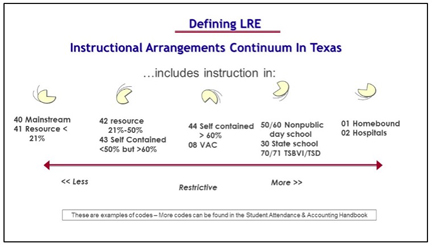
When you get finished using the planning matrix, the ARD committee will be able to see what percentage of the day the student’s instructional arrangement is “outside” of the regular education classroom.
If all special education supports & related services are provided within the general education classroom during the whole day, then the placement, or instructional arrangement, would be “mainstream.”
If your child receives supports and services outside of the general education setting, the percentage of the day will determine the “placement in the least restrictive environment (LRE).”
Here are some very simple examples:
- Resource Room placements may indicate that a student receives special education supports and related services outside of the general education setting for less than 50% of his/her day (i.e. Your student has 7 hour long classes in the day, plus an hour for lunch/recess – then they would be pulled out of the regular education setting for less than 4 hours per day)
- Self-contained placements would indicate that a student receives special education supports and related services outside of the general education setting for more than 50% of the school day.
As you and the ARD committee discuss LRE, be sure to keep an eye on the future. Where do you envision your child as an adult? Remember that whatever environment you create for your child when he or she is young, you must be prepared to replicate that same environment in the adult world.
Progress in the General Curriculum (ESC 20) has created the Least Restrictive Environment Question and Answer document that can help you understand placement.
For more information on various instructional arrangements available along the continuum of placements, please see